





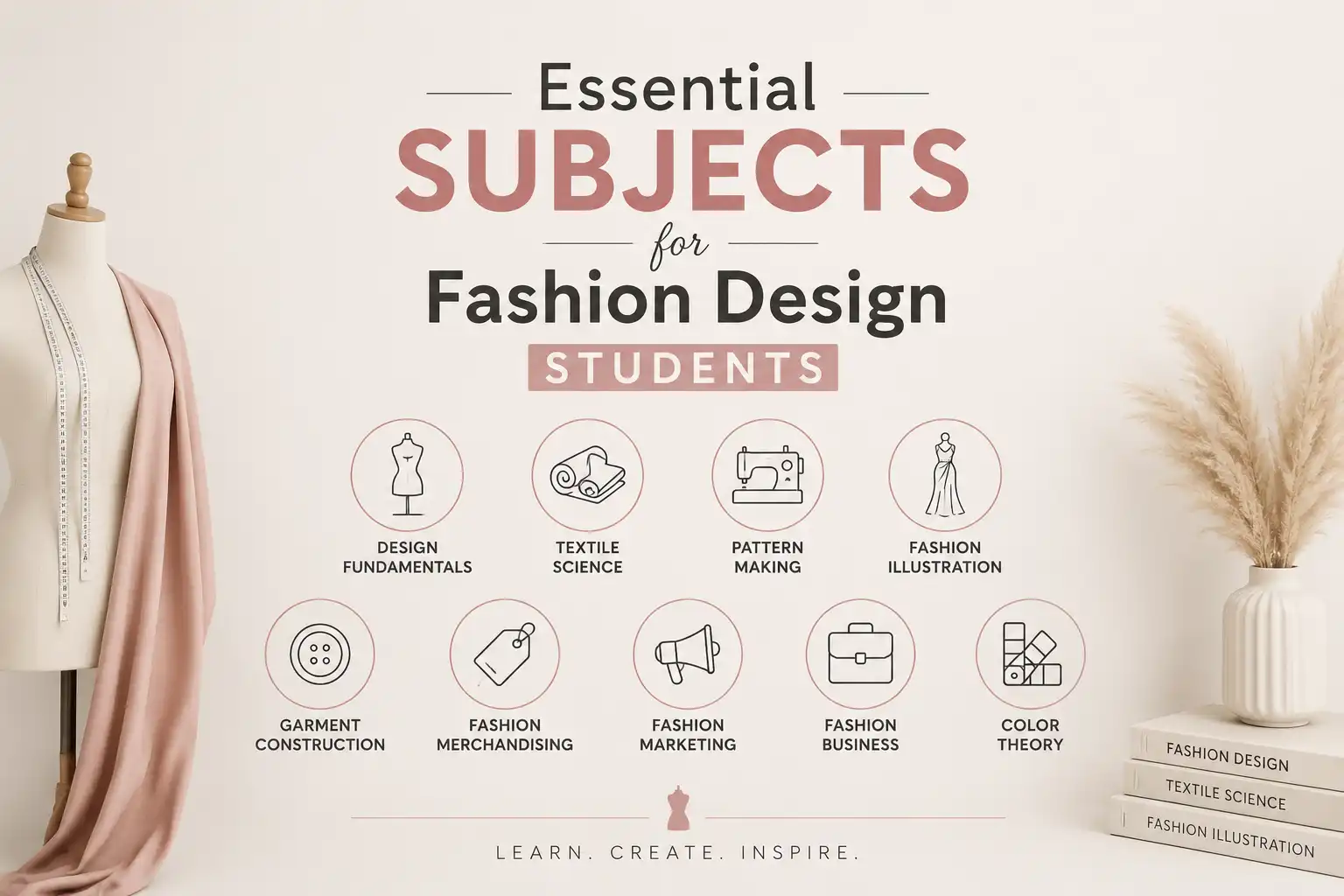
Ask ten fashion design aspirants what they will study, and most will say sketching, sewing and maybe a bit of marketing. The reality is broader. The essential subjects for fashion design students fall into four connected groups: creative foundation subjects, textile and craft knowledge, digital and technical design tools, and business and professional practice, and each one determines how ready a graduate actually is for a design floor, a merchandising desk or their own label.
Below, we break down what these subjects cover, why each one matters, and how a structured programme like the one at NIF Global Udaipur turns them into placement-ready skill rather than scattered theory.
Why the Right Subjects Actually Shape Your Fashion Career
A fashion syllabus is not a random collection of classes. Colour theory feeds directly into how a student chooses fabric later. Pattern making depends on the sketching accuracy built in year one. Business subjects decide whether a talented designer can actually run a label or price a collection correctly. Employers and design houses in India consistently look for graduates who can move from concept sketch to finished, sellable garment without a gap in between, and that ability comes from a curriculum that sequences subjects deliberately rather than teaching them in isolation.
Think of it as a pipeline rather than a list. Foundation subjects shape how a student sees silhouette, colour and proportion. Technical and craft subjects turn that vision into a garment that fits and holds up. Business subjects decide whether that garment ever reaches a customer profitably. Weakness at any stage shows up later, usually during a live collection when there is no time left to relearn the basics.
Foundation Subjects Every Fashion Design Student Must Master
Elements and Principles of Design
This is where every fashion student starts. Balance, proportion, rhythm, harmony and contrast are covered here, along with colour theory and how tone, shade and palette choices affect the way a garment reads on the body. Without this grounding, later subjects like draping or collection development have little to build on.
Fashion Illustration and Sketching
Freehand sketching remains the fastest way to move an idea from imagination to paper, while digital illustration in tools like Adobe Illustrator lets students present polished concepts to buyers and mentors. Students learn croquis drawing, garment detailing (collars, sleeves, silhouettes) and how to build mood boards that communicate a concept before a single seam is cut.
Textile Science
Fabric behaviour decides what a design can actually become. This subject covers fibre types, weaves, dyeing and printing methods, and increasingly, sustainable and organic textile options as Indian brands respond to demand for eco-conscious fashion. A designer who understands drape, elasticity and durability makes far fewer costly mistakes at the sampling stage.
Technical and Digital Design Subjects
Modern fashion runs on digital tools almost as much as on needle and thread, and proficiency here is one of the fastest ways for a graduate to stand out in an interview.
| Software | Primary Use | Why It Matters |
| Adobe Illustrator | Flat sketches, tech packs, colourways | Industry-standard for communicating design intent |
| Adobe Photoshop | Digital rendering, mood boards, textures | Turns raw sketches into presentation-ready visuals |
| CLO 3D / Browzwear | 3D garment simulation and virtual draping | Reduces sampling costs by testing fit digitally first |
| TUKAcad / Optitex | Digital pattern making and grading | Speeds up production-ready pattern development |
| Procreate | Digital illustration on tablet | Fast, portable concept sketching for live briefs |
Learning these tools alongside hand-drawing and hand-draping, rather than instead of them, is what separates a designer who can only follow a trend deck from one who can originate a concept and take it through to a wearable sample.
Pattern Making, Garment Construction and Draping
This is the most hands-on subject group in any fashion syllabus. Students learn drafting and cutting patterns for tops, trousers, skirts and dresses, draping techniques directly on a dress form, sewing and stitching methods across different fabric types, and fitting and finishing to production standard. It is the subject group that turns a flat sketch into a garment someone can actually wear, and most institutes treat it as the technical backbone of the entire course.
Textile Craft, Surface Ornamentation and Embellishment
Beyond basic fabric knowledge, students study techniques like block printing, tie-dye, embroidery and beadwork, along with how different embellishment styles add texture, depth and cultural character to a garment. India’s embroidery traditions, from Zardozi to Kantha to Bandhani, are globally recognised, and a designer who understands these techniques technically, not just aesthetically, has a genuine edge when working with export houses or couture labels that still value hand craftsmanship.
Rajasthan’s Textile Heritage: The Subject Most Guides Never Mention
Most fashion design blogs list the same generic subjects and stop there. Few mention that studying in a craft-rich region like Rajasthan gives students direct access to living textile traditions that cannot be replicated in a classroom slide deck. Udaipur and the surrounding region are home to centuries-old practices in block printing, Bandhani tie-dye, Zardozi embroidery and Rajasthani textile weaving, and institutes that build regional craft exposure into the curriculum through market visits, artisan interactions and heritage-inspired design projects give graduates an authentic point of view that generic, city-agnostic programmes simply cannot offer. This is a subject area that rarely appears in standard “fashion design syllabus” content, yet it directly shapes a designer’s ability to work with luxury and heritage labels that are actively seeking artisans who understand traditional Indian textile work alongside modern silhouettes.
Fashion Marketing, Merchandising and Business Subjects
Fashion is a business as much as an art form, and courses that skip commercial training leave graduates unprepared for retail, merchandising or running their own label. This subject group covers branding and marketing strategy, retail and e-commerce management, consumer behaviour, pricing and inventory management, and increasingly, entrepreneurship modules for students who want to launch a brand rather than join an existing house. Portfolio development sits close to this group too, since a professional portfolio, documented from concept sketch through to final garment, is often what actually gets a graduate shortlisted for a job, more so than marks on a transcript.
Specialised and Luxury Fashion Subjects
As students progress, most programmes introduce specialised electives: luxury fashion and haute couture, bridal and occasion wear, knitwear design, costume design for film and theatre, and sustainable or upcycled fashion. Subjects like Foundation of Luxury and Design Concept and Fashion Future push students beyond mass-market thinking into the kind of conceptual, narrative-driven design work that luxury houses and design competitions expect. These electives matter because they let a student build a specialisation, rather than graduating as a generalist competing with every other fresher in the market.
Career Scope for Fashion Design Graduates in India
Understanding where these subjects lead helps students prioritise their effort. The table below reflects typical roles and salary ranges available to trained fashion design graduates in India.
| Role | Sector | Typical Annual Salary |
| Fashion Designer | Labels, export houses, design studios | INR 3–7 LPA |
| Textile Designer | Textile mills, print and weave studios | INR 6–9 LPA |
| Fashion Merchandiser | Retail brands, e-commerce | INR 3–7 LPA |
| Fashion Stylist | Media, personal styling, brands | INR 2.5–6 LPA |
| Costume Designer | Film, TV, theatre | INR 4–6 LPA |
| Boutique Owner / Entrepreneur | Independent label | INR 10–20 LPA |
With India’s fashion and apparel market continuing to expand across both mass retail and luxury segments, demand for trained graduates who combine craft skill with digital and business fluency keeps rising, particularly outside the traditional metro-only design hubs.
How NIF Global Udaipur Builds These Subjects Into a Career-Ready Curriculum
NIF Global Udaipur, part of the ISID Group’s design education network, structures its Fashion Design programmes, from the three-year B.Voc to the four-year B.Des and postgraduate M.Voc and M.Des, around exactly this progression: foundation, textile and craft knowledge, digital tools, and business practice. The curriculum includes subjects such as Textile Embroidery and Printing, Pattern Making and Garment Construction, World Fashion History, Apparel Marketing Management, and specialised modules like Foundation of Luxury, Luxury and Culture, and Design Studio: Haute Couture, taking students well beyond the basics most competing programmes stop at.
Students train on industry-standard tools including Adobe Illustrator and Photoshop, CLO 3D, TUKAcad and Optitex, and get direct exposure to global fashion practice through the institute’s London Residential Program and participation in the Decorex Festival in London. NIF students have showcased their work at Lakme Fashion Week and received mentorship from industry names including Gauri Khan and Twinkle Khanna, exposure that is genuinely difficult to replicate in a purely classroom-based programme. Being based in Udaipur also means students get direct access to Rajasthan’s textile and craft heritage, block printing, Bandhani and Zardozi among them, as a living resource rather than a textbook chapter.
Conclusion
The subjects that matter most for a fashion design student are the ones that connect creative vision to technical execution: design fundamentals, textile and craft knowledge, digital tools, and business practice, with region-specific exposure like Rajasthan’s textile heritage adding real, differentiated value. Choosing a programme that teaches all four groups, backed by live projects and industry exposure, is what actually determines career readiness after graduation.
Frequently Asked Questions
What are the most important subjects for fashion design students?
Elements of design, fashion illustration, textile science, pattern making and garment construction form the core. CAD software, fashion marketing and specialised electives like luxury design round out a well-structured curriculum.
Do fashion design students need strong drawing skills?
Basic drawing helps, but it is not mandatory before enrolling. Courses teach croquis drawing and digital illustration from scratch, and creativity and observation matter more than being a perfect artist on day one.
Which software should a fashion design student learn first?
Adobe Illustrator and Photoshop are usually the starting point for flat sketches and presentations, followed by pattern tools like TUKAcad or Optitex, and 3D tools like CLO 3D once fundamentals are solid.
Is a degree or diploma better for covering fashion design subjects?
A degree programme (B.Des or B.Voc) covers subjects in far more depth over three to four years, including business, luxury and sustainability modules that shorter diploma courses often compress or skip entirely.
What is the average salary after studying these subjects?
Entry-level fashion designers in India typically earn between INR 3 and 6 LPA, rising to INR 10 LPA and above in specialised roles like textile design, merchandising leadership or running an independent label.
How long does it take to cover all essential fashion design subjects?
A full degree programme spread across six to eight semesters is the standard timeline, moving students from foundational subjects through textile and technical training to specialised and business subjects in sequence.