





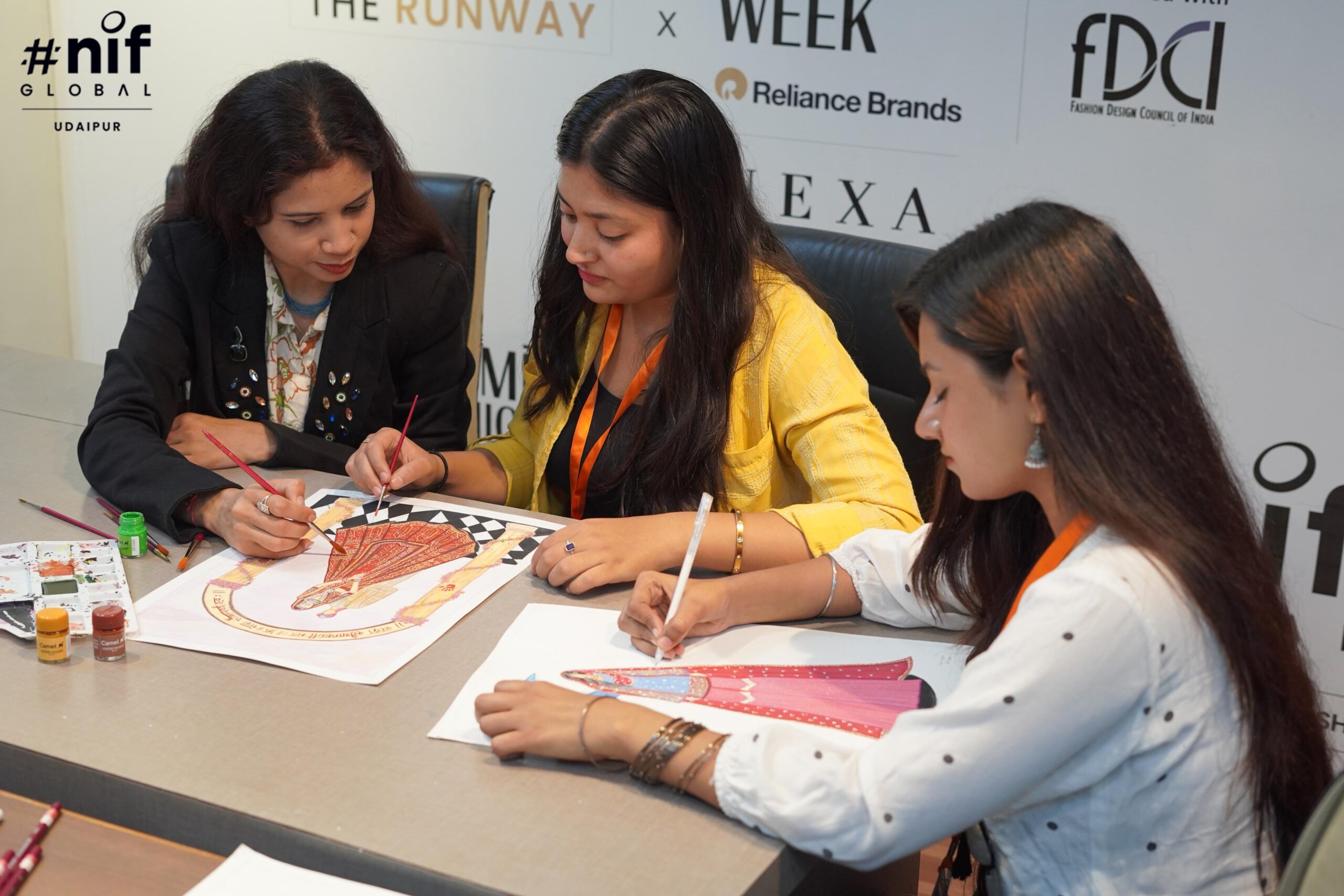
Most people see the final outfit. The clean silhouette, the perfectly draped fabric, the garment sitting exactly right on the model as she walks the runway. What they don’t see is everything that came before it.
The sketchbook pages are filled with crossed-out ideas. The fabric swatches pinned and repinned until something clicked. The late evenings spent unpicking a seam that wasn’t quite right and starting again. The moment a design that only existed in someone’s head finally became something real enough to hold.
That process, from the very first spark of an idea to a finished, wearable piece, is what fashion education is actually about. And for students at NIF Global Udaipur, it’s something they live through hands-on, not just read about in textbooks.
Here’s what that journey genuinely looks like.
It Begins with Observation, Not a Pencil
Most people assume the design process starts with sketching. It actually starts much earlier than that.
Before a fashion student ever puts pencil to paper, they learn to look at the world differently. A pattern on a Rajasthani wall. The way light passes through a sheer fabric in the afternoon. The silhouette of someone’s outfit against the background of a busy street. These aren’t just pretty things to notice; they become visual references that eventually feed into design decisions.
At NIF Global Udaipur, students are encouraged to build this habit of observation early. They keep sketchbooks not just for fashion drawings but for collecting textures, colours, shapes, and references that interest them. Over time, this practice develops into a personal design vocabulary, a visual language that makes their work distinct from everyone else’s.
That distinctiveness is what separates designers who make things that look like everything else from designers who make things that look unmistakably like them.
The Sketch is Just the Beginning of the Conversation
When students do sit down to sketch, the goal isn’t to produce a beautiful drawing. The goal is to think on paper.
A sketch at this stage is essentially a question: what if the neckline sat here? What if the volume was in the skirt rather than the sleeve? What happens to this silhouette if the fabric is stiff versus fluid?
Fashion illustration teaches students to visualise proportion, movement, and drape before they’ve touched any material. It forces them to make decisions early and to understand why those decisions matter. A line that looks fine in a drawing might create an entirely different effect in fabric, and learning to anticipate that gap between imagination and reality is one of the most valuable skills a designer develops.
Students at NIF Global Udaipur work through multiple rounds of sketching and refinement before moving to fabric. It can feel slow at first. But the designers who do this thoroughly tend to waste far less time and material later, because they’ve already solved most of their problems on paper.
Fabric Changes Everything
There’s a moment in every fashion student’s education when they realise that the fabric is not just a material. It’s a collaborator.
The same design executed in a structured cotton versus a flowing georgette is essentially two different garments. Fabric has its own personality. It moves in ways you don’t expect, catches light differently at different angles, and responds to the body in ways that no drawing can fully predict.
Learning to understand fabric is one of the more humbling parts of fashion education. Students who come in thinking they know what a design will look like often get surprised the first time they drape it on a dress form. The fabric does something they didn’t plan for. And sometimes, what the fabric does is actually better than what they had in mind.
This is where pattern making and construction skills become essential. Understanding how to cut and assemble a garment, how to build structure into a piece or let it remain fluid, how to handle different materials with the techniques they each require. These are the foundations that give a designer real control over their work.
Without them, you’re guessing. With them, you’re making informed creative decisions.
The Part Nobody Talks About: When Things Go Wrong
No fashion student gets through their education without a project that humbles them.
A seam that puckers no matter what you do. A collar that won’t lie flat. A colour that looked perfect in the swatch and completely wrong once it was made into a garment. Deadline pressure that leads to a decision you regret the moment you see it finished.
These moments are not failures. They’re where the real learning happens.
Problem-solving under constraint is one of the most important skills a working designer needs, and you can only develop it by actually encountering problems. The students who handle these moments with curiosity rather than frustration are the ones who come out of the experience better designers.
At NIF Global Udaipur, students work on live projects and real briefs throughout their course, which means they encounter real problems with real consequences. Not everything goes perfectly. But that’s precisely the point.
Styling, Presentation, and the Story Behind the Collection
A garment doesn’t exist in isolation. It exists in the context of how it’s worn, how it’s shown, and what story it tells alongside the other pieces it sits with.
This is why fashion students also spend time learning about styling, collection building, and presentation. How do you create a cohesive body of work where each piece feels like it belongs with the others? How do you show your collection in a way that communicates the idea behind it, not just the clothes themselves?
Fashion shows, portfolio presentations, and industry showcases are all part of the NIF Global Udaipur experience. These aren’t just performance moments. They teach students how to articulate their creative vision to an audience, which is a skill they’ll need whether they’re presenting to a client, pitching to a retailer, or building a brand of their own.
Alumni like Neha Kumawat, whose label Sitara blends traditional Indian craftsmanship with contemporary design, and Shubhangi Agarwal, whose brand Likha reached global platforms including the Dior fashion show, both went through this same process of learning to present their work with intention and clarity. That ability to communicate a vision, not just execute it, is a significant part of what took their work from student collections to recognised brands.
What the Process Actually Teaches You
By the time a fashion student reaches their final collection, the skills they’ve built go well beyond making clothes.
They’ve learned to manage a creative process from beginning to end, including all the ambiguity and problem-solving that comes with it. They’ve developed the discipline to work through stages that feel frustrating before they feel rewarding. They’ve built the ability to receive feedback on work that feels personal and use it constructively rather than defensively.
And they’ve learned something that’s harder to teach but crucial to a design career: how to trust their own instincts while remaining genuinely open to what the material, the brief, or the audience is telling them.
These are not just fashion skills. They travel well into almost any creative profession.
The Moment It Comes Together
Ask any fashion student what the moment feels like when a garment they designed is finally finished and on a body, moving the way they imagined it would, and they’ll usually pause before answering.
It’s difficult to describe. Relief is part of it. Pride is definitely part of it. But there’s also something quieter than that. A recognition that an idea that only existed in their head is now real. Now tangible. Now something someone else can see, wear and experience.
That moment is what the whole process is working toward. And it never quite gets old, even for designers who have been doing it for years.
Thinking About Starting Your Own Journey?
The process described here is not reserved for people with extraordinary talent. It’s available to anyone willing to show up, pay attention, and do the work consistently.
Every designer whose name you know started with a blank page and a lot of unanswered questions. Education is what helped them develop the skills and confidence to answer those questions, one collection at a time.
If you’re curious about fashion design and wondering whether it’s the right path for you, the best thing you can do is start. Sketch something, even badly. Visit a fabric market and pay attention to what you’re drawn to. Talk to people who are already studying or working in the field.
Your creative instincts are already there. The training is what gives them somewhere to go.
Explore fashion design programs at NIF Global Udaipur and take the first step from idea to creation.