






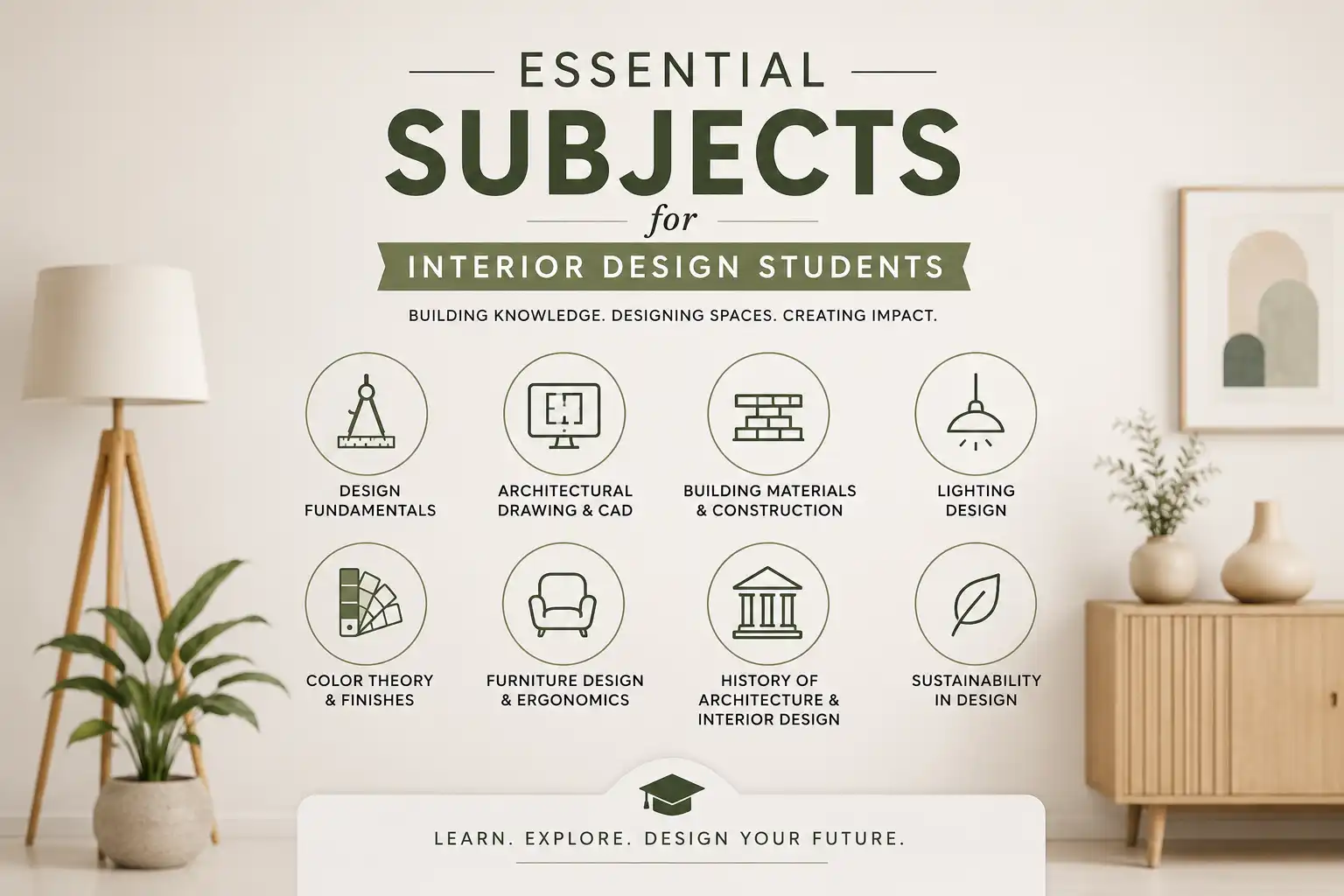
Every student who considers interior design eventually asks the same question: what will I actually study? The answer matters more than most people realise, because the subjects in your syllabus decide whether you graduate with a portfolio clients trust or a stack of certificates that say little about your ability. The essential subjects for interior design students fall into four groups: design fundamentals, technical and software skills, space and materials knowledge, and professional practice, each one feeding directly into the work you will do on a live project.
Below, we break down what these subjects cover, why they matter, and how a well-structured course like the one at NIF Global Udaipur turns classroom learning into placement-ready skill.
Why the Subjects You Study Actually Shape Your Career
A design degree is not a checklist of unrelated topics. Colour theory informs the material choices you make later. Space planning depends on the drawing skills you learn in year one. Building services knowledge decides whether your “beautiful” layout is actually safe to construct. Employers in India’s residential and commercial design sector consistently look for graduates who can move between creative concepts and technical execution without a gap, and that ability is built subject by subject, not overnight.
Think of the syllabus as a pyramid rather than a list. Foundation subjects sit at the base and shape how you see a space at all. Technical subjects sit in the middle and turn that vision into drawings a contractor can actually follow. Professional practice sits at the top, where creative and technical skill meet client budgets, timelines and real construction constraints. Weakness at any one level shows up later, usually during a live project when there is no time left to go back and learn the basics.
Foundation Subjects Every Interior Design Student Must Master
Design Principles and Elements
This is where every interior designer starts. Students learn how line, shape, texture, proportion, balance, rhythm and contrast combine to create spaces that feel intentional rather than accidental. Without this grounding, later subjects like furniture design or lighting have nothing to build on.
Colour Theory
Colour affects mood, perceived room size and even client satisfaction with a finished project. This subject covers colour psychology, palette building and the practical application of colour across walls, fabrics, furniture and lighting, so students can defend their choices with more than personal taste.
Drawing, Sketching and Visual Communication
Freehand sketching remains the fastest way to develop and pitch an idea, while technical drawing (floor plans, elevations, sections) is how that idea gets built. Digital sketching bridges the two, letting students present polished concepts to clients before a single wall is touched.
Technical and Software Subjects for Professional Practice
Design ideas only become real projects once they can be drafted, modelled and shared with contractors. Interior design courses therefore dedicate significant time to industry-standard software, and proficiency here is one of the fastest ways to stand out in a placement interview.
| Software | Primary Use | Why It Matters |
| AutoCAD | 2D drafting, floor plans, technical layouts | The baseline standard for construction-ready drawings |
| SketchUp | 3D modelling and quick concept visualisation | Helps clients understand a space before it exists |
| 3ds Max | Advanced 3D rendering and visualisation | Produces photorealistic presentations for high-value clients |
| Revit | Building Information Modelling (BIM) | Coordinates architecture, interiors and services on one model |
| Lumion / Enscape | Real-time rendering and walkthroughs | Speeds up client sign-off with immersive previews |
| Photoshop / Canva | Mood boards and presentation decks | Turns raw material and colour research into a persuasive pitch |
Learning these tools alongside hand-drawing, rather than instead of it, is what separates a designer who can only follow a template from one who can originate a concept and then execute it professionally.
Space Planning, Materials and Building Systems
Space Planning and Interior Architecture
Space planning subjects teach layout logic, circulation, zoning and how to align an interior scheme with the structural bones of a building. A designer who understands architectural constraints early avoids costly redesigns later, which is exactly why this subject sits close to the centre of most curricula.
Materials and Textiles
Every finish decision, wood, stone, metal, glass, fabric, carries trade-offs in cost, durability and maintenance. This subject trains students to match materials to a brief realistically, including a growing focus on sustainable and low-VOC options as Indian clients ask for eco-conscious interiors more often.
Building Services: Electrical, Plumbing, HVAC and Fire Safety
Interiors are not just visual layers over a structure; they interact with real infrastructure. Students study electrical distribution, plumbing and drainage, heating and ventilation, and fire safety planning, because a design that ignores these systems cannot legally or practically be built.
Specialised Subjects: Furniture, Lighting and Sustainable Design
Furniture design teaches custom piece development, ergonomics and construction knowledge, so students can design seating and storage that actually suits the human body and the space available. Lighting design covers ambient, task and accent lighting, along with basic acoustics, both of which shape how a finished room actually feels to live or work in. Sustainable design, increasingly a standalone module rather than a footnote, introduces energy-efficient systems, responsibly sourced materials and passive design strategies suited to India’s climate range.
Vaastu Shastra: The India-Specific Subject Most Guides Skip
Most interior design blogs list the same global-standard subjects and stop there. In India, however, a large share of residential clients still expect their designer to at least understand Vaastu Shastra principles around spatial orientation, energy flow and room placement. Institutes that build Vaastu literacy into the curriculum, rather than treating it as optional trivia, give graduates a genuine edge when working with Indian homeowners, builders and joint family clients who factor this into every major renovation decision. It is a subject that rarely appears in generic “interior design syllabus” content, yet it directly affects a designer’s ability to close residential projects across Rajasthan and much of the country.
Professional Practice and Business Subjects
Interior design is a client-facing profession, and courses that skip business training leave graduates unprepared for freelancing or studio life. This subject group covers budgeting and cost estimation, vendor and contractor coordination, project scheduling, contracts, and client communication. Some programmes extend into entrepreneurship and basic marketing, useful for students who plan to launch their own design practice rather than join an existing firm straight after graduation.
Portfolio development usually sits alongside these subjects too. Students learn to document projects properly, from concept sketches through to finished renders, because a strong portfolio is often what actually gets a graduate shortlisted for an interview, more so than the marks on a transcript. Communication training also covers how to present a concept to a client who has no design background, translating technical decisions into language a homeowner or business owner can act on.
Career Scope for Interior Design Graduates in India
Understanding where these subjects lead helps students prioritise their effort. The table below reflects typical roles and salary ranges available to trained interior designers in India.
| Role | Sector | Typical Annual Salary |
| Residential Interior Designer | Homes, apartments, villas | INR 5–12 LPA |
| Commercial Interior Designer | Offices, retail, real estate | INR 6–18 LPA |
| Hospitality Interior Designer | Hotels, restaurants, resorts | INR 6–18 LPA |
| Lighting Designer | Architecture studios, events | INR 5–15 LPA |
| Furniture Designer | Manufacturing, design consultancies | INR 4–10 LPA |
| Sustainable Design Consultant | Architecture, real estate | INR 8–20 LPA |
With 72 percent of people in India’s tier-1 cities preferring to hire professional interior designers for their homes, the demand side of this equation continues to grow, particularly outside the metro-only markets that dominated the industry a decade ago.
How NIF Global Udaipur Builds These Subjects Into a Career-Ready Curriculum
NIF Global Udaipur, part of the ISID Group’s design education network, structures its Interior Design programmes, from the three-year B.Voc to the four-year B.Des and postgraduate M.Voc and M.Des, around exactly this progression: foundation, technical software, space and materials, and professional practice. The institute is UGC-approved and affiliated with the Indian Institute of Interior Designers (IIID), and its faculty includes practising architects such as Ar. Riya Gajjar and Ar. Rishita Goswami alongside HOD Siddharth Sharma, so classroom learning stays connected to live studio work rather than theory alone.
Students train on the same software covered above, AutoCAD, SketchUp, 3ds Max, Revit and Lumion, and get direct exposure to global design practice through the institute’s participation in the Decorex Festival in London and its London Residential Program. A dedicated Vaastu Course sits alongside the core interior design curriculum, addressing the India-specific gap most competing programmes leave unfilled. Students have also presented work at Lakme Fashion Week and received mentorship from industry names including Gauri Khan and Twinkle Khanna, exposure that is difficult to replicate in a purely theoretical classroom.
Conclusion
The subjects that matter most for an interior design student are the ones that connect creative thinking to technical execution: design fundamentals, software proficiency, space and materials knowledge, and professional practice, with India-specific subjects like Vaastu Shastra adding real market value. Choosing a course that teaches all four groups, backed by live projects and industry exposure, is what actually determines career readiness after graduation.
Frequently Asked Questions
What are the most important subjects for interior design students? Design principles, colour theory, space planning, CAD software and materials studies form the core. Building services, furniture design and professional practice round out a well-structured curriculum.
Do interior design students need to learn Vaastu Shastra? It is not mandatory everywhere, but in India it gives graduates a practical edge, since many residential and commercial clients expect a designer to understand basic Vaastu principles before finalising a layout.
Which software should an interior design student learn first? AutoCAD is usually the starting point for technical drafting, followed by SketchUp for 3D concepts and Photoshop for presentations. Revit and 3ds Max are typically introduced once fundamentals are solid.
Is a degree or diploma better for interior design subjects coverage? A degree programme (B.Des or B.Voc) covers subjects in far more depth over three to four years, including business and sustainable design modules that shorter diploma courses often compress or skip.
What is the average salary after studying these subjects? Entry-level interior designers in India typically earn between INR 4 and 8 LPA, rising to INR 12–20 LPA in specialised roles like sustainable design consulting or senior commercial design positions.
How long does it take to cover all essential interior design subjects? A full degree programme spread across six to eight semesters is the standard timeline, allowing students to move from foundational subjects to specialised and professional practice subjects in a structured sequence.
Start Building Your Interior Design Foundation the Right Way
If you are comparing interior design programmes in Udaipur or Rajasthan, look closely at how each one sequences these subjects and whether it includes India-specific training like Vaastu Shastra. NIF Global Udaipur’s Interior Design programmes cover the full subject range outlined above, backed by industry-experienced faculty and real project exposure.