






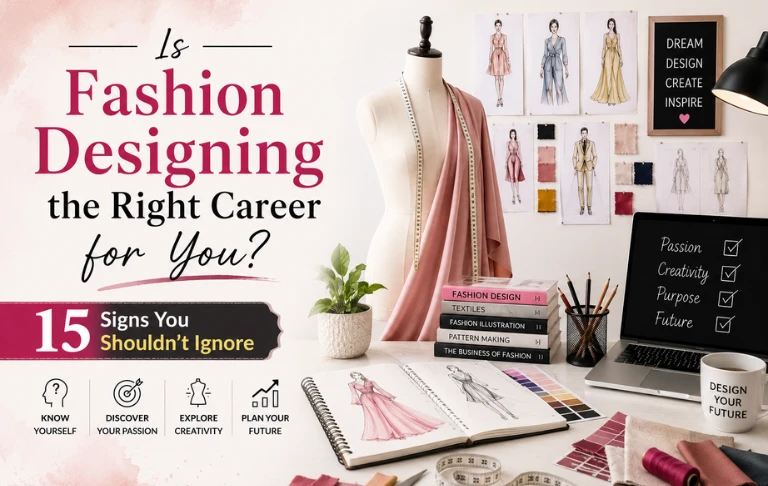
Fashion design looks glamorous from the outside: sketchbooks, fabric swatches, runway shows. But it’s also one of the most demanding creative careers out there, built on late nights, tight deadlines, and constant reinvention. So how do you know if it’s actually right for you, and not just something you like the idea of?
This guide covers the 15 real signs to watch for, the red flags that suggest it might not be your path, what the career actually pays and looks like day-to-day, and how to test your instinct before you commit to a program.
15 Signs Fashion Designing Could Be Right for You
1. You Notice Clothes Before You Notice Anything Else
When you walk into a room, your eyes go to what people are wearing before you register anything else: the cut of a jacket, an unusual fabric, how someone styled a basic outfit. This isn’t vanity; it’s the visual instinct designers rely on daily to spot what works and what doesn’t.
2. You Can’t Stop Sketching or Modifying Clothes
Maybe you doodle outfit ideas in the margins of your notebook. Maybe you’ve altered a plain kurta into something entirely your own. If you’re already designing informally for yourself, friends, or just on paper, that habit is a strong early signal, not a coincidence.
3. You Understand Fabric, Not Just Silhouette
Loving how clothes look is common. Caring about how a fabric drapes, breathes, or behaves under stitching is rarer, and it’s the difference between someone who admires fashion and someone built to design it. If you find yourself touching fabric in stores to judge quality, take note.
4. You’re Comfortable with Constant Trend-Chasing
Fashion never sits still. What’s relevant this season can feel dated the next. If tracking runway shows, streetwear shifts, and social media trend cycles feels energising rather than exhausting, you’re wired for an industry that never stops moving.
5. You Have Patience for Repetition and Precision
Design school and studio work involve far more repetition than people expect: redrawing a sleeve pattern for the tenth time, adjusting a seam by a few millimetres, redoing a toile until it fits right. Designers who last in this field genuinely don’t mind the grind behind the glamour.
6. You Can Take Harsh Feedback Without Shutting Down
Critique in design studios is direct, frequent, and sometimes blunt. If your instinct is to defend your work rather than improve it, that’s worth examining early. The designers who grow fastest are the ones who treat feedback as data, not attack.
7. You Think in Problems, Not Just Pretty Pictures
A good designer doesn’t just ask “does this look nice?” they ask “does this fit the brief, the budget, the body, the season, the client?” If you naturally think about constraints alongside creativity, you already have a designer’s mindset.
8. You’re Drawn to Business, Not Just Beauty
Design careers, especially running your own label, require pricing sense, vendor negotiation, marketing, and basic financial literacy. If the business side of fashion interests you rather than intimidates you, that combination of creativity and commercial sense is exactly what the industry rewards.
9. You Have Decent Illustration Skills, or You’re Willing to Build Them
You don’t need to be a fine artist, but you should be comfortable, or willing to become comfortable, translating an idea in your head onto paper or a screen. Design software is part of this too; tools like Adobe Illustrator, Adobe Photoshop, CorelDRAW, CLO3D, Browzwear, and pattern-making CAD software are now standard across the industry, and any structured program will teach them from the ground up.
10. You Can Handle High-Pressure Deadlines
Collections don’t wait. Fashion weeks, buyer meetings, and production timelines are fixed, and the work has to be ready regardless of how the process went. If you tend to do your best work under real-time pressure rather than falling apart, that’s a genuinely useful trait here.
11. You’re Curious About Different Cultures and Craft Traditions
Some of the strongest design work today draws on traditional techniques Indian embroidery, handloom weaves, regional textile crafts reinterpreted for a modern audience. Designers with real curiosity about where fabrics and techniques come from tend to produce work with more depth than those chasing trends alone.
12. You Notice What People Actually Wear, Not Just What’s on the Runway
Runway shows get attention, but most design careers are built on translating that inspiration into clothes real people will buy and wear. If you naturally think about wearability, comfort, and everyday practicality alongside creative vision, that’s a commercially useful instinct.
13. You Care About Sustainable and Ethical Fashion
Sustainability isn’t a niche interest anymore; it’s shaping how the entire industry designs, sources, and produces. If you find yourself drawn to upcycling, ethical sourcing, or solving the environmental problems fast fashion has created, that curiosity lines up with where the industry is investing.
14. You Can Network Without Feeling Fake About It
Much of a fashion career placements, freelance clients, brand collaborations comes through relationships: professors, mentors, vendors, fellow designers. If you’re genuinely interested in people and comfortable building professional relationships, that will open doors that talent alone won’t.
15. The Idea of a “9-to-5” Feels Wrong to You
Fashion careers, especially entrepreneurial ones, rarely run on fixed hours. Production emergencies, last-minute fittings, and seasonal crunches don’t respect a clock. If the unpredictability of that excites you more than it worries you, that’s a meaningful sign.
Quick Self-Assessment: Score Yourself
Count how many of the 15 signs above genuinely describe you, then check where you land:
- 12–15 signs: Fashion design is likely a strong fit. It’s worth exploring formal training seriously.
- 8–11 signs: You have solid potential. Consider a short workshop or foundation course before committing to a full program.
- 4–7 signs: You may enjoy fashion as an interest, but it’s worth learning more about the day-to-day reality before deciding.
- 0–3 signs: Fashion might not be the strongest fit right now. Adjacent creative fields, such as textile design, styling, and visual merchandising, could still be worth exploring.
Fashion Designing May Not Be the Right Career If…
Honesty matters here as much as encouragement. This path may not suit you well if:
- You dislike revisions and prefer to finish something once and move on.
- You want predictable, fixed working hours.
- You expect quick success immediately after graduation.
- You don’t enjoy continuously learning new tools, techniques, or trends.
- You lose motivation quickly after criticism.
- You’re mainly attracted to the glamour of fashion shows rather than the process behind them.
- You’re uncomfortable working closely with clients, vendors, or teams.
None of these is a permanent deal-breaker; most are habits and mindsets that can shift with exposure and training. But they’re worth being honest with yourself about before you commit time and money to a design program.
The Reality of a Career in Fashion Design
Fashion design is creatively rewarding, but the day-to-day is less about inspiration and more about execution. Expect to spend real time on:
- Meeting production and delivery deadlines
- Sourcing fabric and working with suppliers
- Troubleshooting garment fit and construction issues
- Budgeting and costing collections
- Presenting concepts and defending design choices
- Responding to client or brand feedback, often repeatedly
Students often discover during their first semester that fashion design involves far more pattern-making, fittings, and technical refinement than they initially expected. Those who enjoy solving these hands-on challenges, not just the sketching part, tend to adapt well to the profession and stay in it long-term.
Passion Alone Isn’t Enough
Loving fashion is a genuine starting point, but it’s rarely sufficient on its own. Designers who build lasting careers also develop:
- Clear communication and presentation skills
- Time management under real deadlines
- Technical and software proficiency
- Teamwork and collaboration with production staff
- Basic business and pricing awareness
The good news is that none of these is fixed traits; they’re skills, and structured design programs are built specifically to develop them alongside your creative ability.
Common Myths About Fashion Designing
Myth: You have to be amazing at drawing to succeed. Reality: Illustration skills matter for communicating ideas quickly, but they improve with practice and training; they’re rarely the deciding factor in a designer’s success.
Myth: Fashion designing is only about glamour and fashion shows. Reality: Most of the actual work happens behind the scenes: pattern development, fittings, sourcing, and production troubleshooting.
Myth: Only a handful of celebrity designers actually succeed. Reality: Far more designers build stable, rewarding careers in retail, export houses, textile manufacturing, styling, and independent small labels than ever reach celebrity status, and most don’t need to.
What Can You Earn as a Fashion Designer in India?
Fresh graduates typically start in roles such as Assistant Fashion Designer, Apparel Designer, Fashion Illustrator, Merchandiser, or Textile Designer. Actual pay varies significantly depending on the city, employer, your specific skill set, and, importantly, the strength of your portfolio and internship experience going in.
As a general pattern: entry-level roles tend to sit in a more modest range early on, while designers who build strong portfolios, specialise in high-demand niches, or eventually launch their own label typically see meaningfully higher earning potential over time. Because these figures shift with the market, it’s worth verifying current numbers on salary-tracking platforms or directly with recruiters rather than relying on any single fixed figure.
Career Options After Fashion Design
Studying fashion design doesn’t lock you into one job title. Career paths students go on to pursue include:
- Fashion Designer
- Apparel Designer
- Costume Designer (film, television, theatre)
- Textile Designer
- Fashion Stylist
- Fashion Illustrator
- Fashion Entrepreneur / Label Owner
- Fashion Buyer
- Fashion Merchandiser
- Trend Forecaster
- Visual Merchandiser
- Production Manager
This range is exactly why niching down early, once you understand your strengths, matters more than trying to be equally good at everything.
Fashion Design Is Changing Fast
India’s apparel and textile sector remains a significant contributor to manufacturing employment and export revenue, and the industry designers are entering today looks different from even five years ago. Expect growing overlap with:
- AI-assisted design and trend forecasting tools
- 3D garment visualisation and digital sampling (CLO3D, Browzwear)
- Sustainable and circular fashion practices
- D2C and e-commerce-first fashion brands
- Digital-first marketing and personal branding on Instagram and Pinterest
Students entering the field now need both strong creative fundamentals and comfort with digital tools, which is why choosing a program that actively teaches both matters more than ever.
Before You Commit: Build a Small Test Portfolio
One of the most reliable ways to test your instinct is to try the work before you formally commit to it. Put together a small, low-pressure portfolio including:
- A few original sketches or design concepts
- A simple mood board built around a theme you like
- Small fabric experiments or swatches
- A redesign of an existing garment you own
- An upcycled piece made from something old
You don’t need this to be polished or “portfolio-ready.” You only need enough of it to notice whether you actually enjoy the process, not just the idea of the outcome.
Frequently Asked Questions
Do I need to be good at drawing to become a fashion designer?
No. Strong illustration skills help you communicate ideas faster, but they’re not a prerequisite. Design thinking solving problems through form, fabric, and function matters more, and drawing skills can be developed through structured training.
Is fashion designing a good career in India right now?
Yes. India’s fashion and apparel market is among the fastest-growing in the world, driven by e-commerce platforms, rising disposable incomes, and growing global demand for Indian textiles and craftsmanship, which is creating steady demand for trained designers across design, merchandising, and production roles.
What if I love fashion but hate the business side?
You can still build a design career working within an established brand or design house, where roles are often more specialised and business functions merchandising, sourcing, marketing are handled by dedicated teams. Entrepreneurship isn’t the only path.
How do I know if I should study fashion design or just pursue it as a hobby?
If you’re drawn to several of the signs above trend-tracking, fabric knowledge, business curiosity, deadline resilience formal training will accelerate your growth and open doors, like internships, placements, and industry mentorship, that self-teaching alone usually can’t.
What skills does fashion design school actually teach beyond sketching?
A structured program covers pattern making, draping, garment construction, textile science, trend forecasting, portfolio development, and increasingly, digital design software and business fundamentals the full pipeline from concept to a finished, sellable garment.
Can I make good money as a fashion designer in India?
It’s possible, but it typically takes time. Entry-level salaried roles start modestly, while designers who build strong portfolios, gain specialised experience, or launch a successful label independently tend to see significantly better long-term earning potential.
Still Unsure? Here’s a Simple Next Step
If you’re still deciding, spend a few hours visiting a fashion design studio, sitting in on a workshop, or reviewing student portfolios in person. Experiencing the design process firsthand the fittings, the revisions, the problem-solving usually gives far more clarity than reading about it ever will.
If you decide formal training is the right next step, NIF Global Udaipur’s Fashion Design program combines studio practice, technical and digital skill-building, and industry exposure to help students develop both the creative and professional instincts this career actually demands. The curriculum is UGC-approved and backed by international affiliations.
Explore the Fashion Design program, see where our graduates have gone on the Placements page, read student journeys on Success Stories, or Apply Now to take the next step.
The best way to know if fashion design is right for you isn’t by asking whether you love clothes; it’s by asking whether you enjoy the entire process of turning ideas into wearable products. If you enjoy creativity, problem-solving, continuous learning, and attention to detail, fashion design can become a deeply rewarding career.